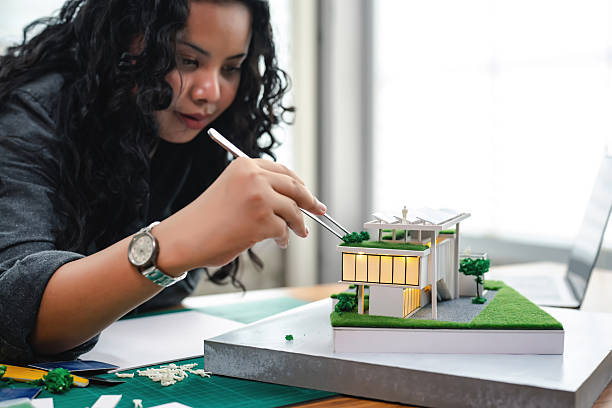
Walk through the operations centre of any major industrial facility in India and you will likely find at least one highly detailed physical model somewhere on the premises. It might be a complete replica of the manufacturing floor at a scale that lets engineers stand over it and see every conveyor line, every machine bay, every access corridor. It might be a cross-section model of a specific piece of machinery that trainee operators use to understand how the system works before they touch the real thing. It might be a beautifully finished model of the entire plant complex that sits in the boardroom for investor visits.
These models have not been replaced by 3D CAD files, BIM platforms, or immersive digital simulations. In every industrial and engineering context where they appear, they serve purposes that digital representations continue to fall short of — and they do so because of qualities that are inherent to physical objects rather than deficiencies in digital technology that the next software release will eventually fix.
Understanding Complex Systems in Three Dimensions
Industrial facilities are among the most spatially complex environments that human beings design and build. A petrochemical plant or a power generation facility contains kilometres of piping, hundreds of valves, multiple interconnected process units, electrical cable runs, structural steelwork, safety systems, access platforms, and emergency egress routes — all occupying shared three-dimensional space and all required to work together without conflict. The challenge of designing such a facility is extraordinary. The challenge of communicating that design to everyone who needs to understand it — engineers, contractors, operators, maintenance technicians, safety officers, and regulators — is arguably even greater.
Working with a reputable model making company india to produce accurate physical representations of industrial systems addresses this communication challenge in a way that purely digital tools cannot fully replicate. A physical piping model, for example, lets engineers and operators physically trace routes through the system, identify access constraints, and understand spatial relationships that even the best 3D CAD software can obscure when rendered on a flat screen. The act of physically moving around and engaging with a model activates spatial understanding in a way that screen-based interaction does not consistently achieve.
This advantage is not confined to the engineering and design phase of a project. It extends throughout the operational life of the facility. Maintenance teams who trained with physical models of the systems they work on consistently demonstrate better spatial understanding of those systems than those who trained exclusively with manuals and screen-based simulations. Safety drill planners who can physically walk through a model of the facility’s emergency egress routes can develop and test evacuation procedures more effectively than those working from floor plans alone.
The Piping Model – A Specialist Application
Of all the types of industrial scale model, the piping model is perhaps the most specialised and the most demanding to produce accurately. Process plant piping systems are genuinely three-dimensional in a way that most other engineered systems are not — they run in all three spatial dimensions simultaneously, pass through structural elements, connect to equipment at specific orientation angles, and must be accessed for maintenance in ways that impose specific clearance requirements around every valve, instrument, and connection point.
Producing an accurate physical piping model requires not only precise replication of the pipe sizes, routes, and connection points at scale, but also faithful representation of the supporting structure, the equipment items that the pipes connect to, and the access ways that allow maintenance personnel to reach every serviceable component. This level of accuracy demands close collaboration with the engineering team responsible for the design, access to the actual design documentation rather than simplified summaries, and production capabilities that can handle the complexity of representing dozens of interconnected systems simultaneously.
When done well, a physical piping model is one of the most powerful tools available for engineering review. Experienced engineers examining a physical model can identify clashes, access problems, maintenance difficulties, and operability issues that software-based clash detection routinely misses because it applies algorithmic rules rather than human engineering judgment informed by operational experience.
Marine and Offshore Models – Precision at Sea
The marine and offshore engineering sector has some of the most demanding requirements for physical scale model accuracy of any industry. Ship hulls must be modelled with precise hydrodynamic form to be useful for flow testing and design review. Offshore platform topsides must represent the complex arrangement of process equipment, piping, structural members, and safety systems accurately enough to serve as a reference for installation planning and operations training. Ship interior models must faithfully represent the arrangement of accommodation spaces, machinery spaces, and cargo areas to be useful for interior planning and crew familiarisation.
The production of marine and offshore models requires specialist knowledge of naval architecture and offshore engineering alongside the general model making skills required for any complex three-dimensional representation. Firms with this specialist experience are genuinely rare, and accessing their expertise can make a meaningful difference to the quality and usefulness of the finished model.
Master Plan Models for Infrastructure and Urban Development
At the other end of the scale spectrum from highly detailed plant models, master plan models represent entire development sites, urban districts, or infrastructure corridors at scales that allow stakeholders to understand spatial relationships and development context. These models are used in planning applications, public consultation exercises, investor presentations, and the offices of government bodies responsible for overseeing large-scale development.
The challenge of master plan model making is different from that of detailed engineering models. Rather than demanding component-level accuracy, master plan models require accurate representation of the relationships between many elements at a scale that allows the overall composition to be understood clearly. Site topography, street layout, building massing, green space allocation, and infrastructure connections all need to be represented at a level of fidelity that communicates the essential character of the development without becoming unreadably cluttered.
Good master plan models achieve a careful balance between detail and clarity. They show enough to be informative and persuasive without showing so much that the essential spatial narrative of the development is lost in a mass of undifferentiated detail. Achieving this balance requires genuine design skill and experience of how different audiences read and respond to models at different scales.
Why Professional Quality Matters
The temptation to reduce model making costs by compromising on quality is understandable but almost always counterproductive. A model that misrepresents proportions, uses materials that look cheap at the scales involved, or lacks the detail needed to be genuinely informative does not serve its purpose regardless of what it costs to produce. Worse, it can actively damage the credibility of the presentation it is supposed to support — a poorly made model communicates a lack of attention to quality that audiences may associate with the project itself.
Professional model makers bring not just technical skills but also the experienced judgment needed to make the dozens of decisions that arise in the course of any model making project — which details to include, which to simplify, which materials will look best at the intended scale, how to handle the transition between highly detailed and broadly representational areas of the same model. This judgment is the product of experience with many different types of models across many different project contexts, and it cannot be replicated by someone producing their first model regardless of how much technical skill they bring to the task.
Selecting the Right Studio for Industrial and Engineering Work
When commissioning an industrial or engineering model, the most important criteria are relevant experience, production capability, and demonstrated accuracy. A studio with an extensive architectural portfolio but no industrial work may not have the engineering knowledge needed to produce an accurate piping or process plant model. Conversely, a studio that specialises in industrial models may not have the aesthetic sensibility needed to produce a master plan model that communicates effectively to a non-technical audience.
For businesses across India that need the full spectrum of professional model making capability — from highly technical engineering models to beautifully presented architectural and master plan models — working with an established scale model making company india that has demonstrated competence across all of these application areas is the most reliable approach. Pal Design Models has built exactly this breadth of capability through years of working with clients across the architecture, real estate, engineering, industrial, and marine sectors. Their New Delhi base, combined with their capacity to serve clients across India’s major cities, makes them a practical choice for any organisation seeking professional model making support for projects of any type or scale.
Whether the requirement is for a piping model that will serve as the engineering reference for a process plant modification, a master plan model for a major urban development presentation, a ship hull model for a naval architecture review, or an architectural model for a residential sales gallery, the combination of technical knowledge, production technology, and professional craft that a studio like this brings is the foundation of a model that will genuinely serve its purpose — and serve it well enough to justify the investment it represents.